Getting Started Process:
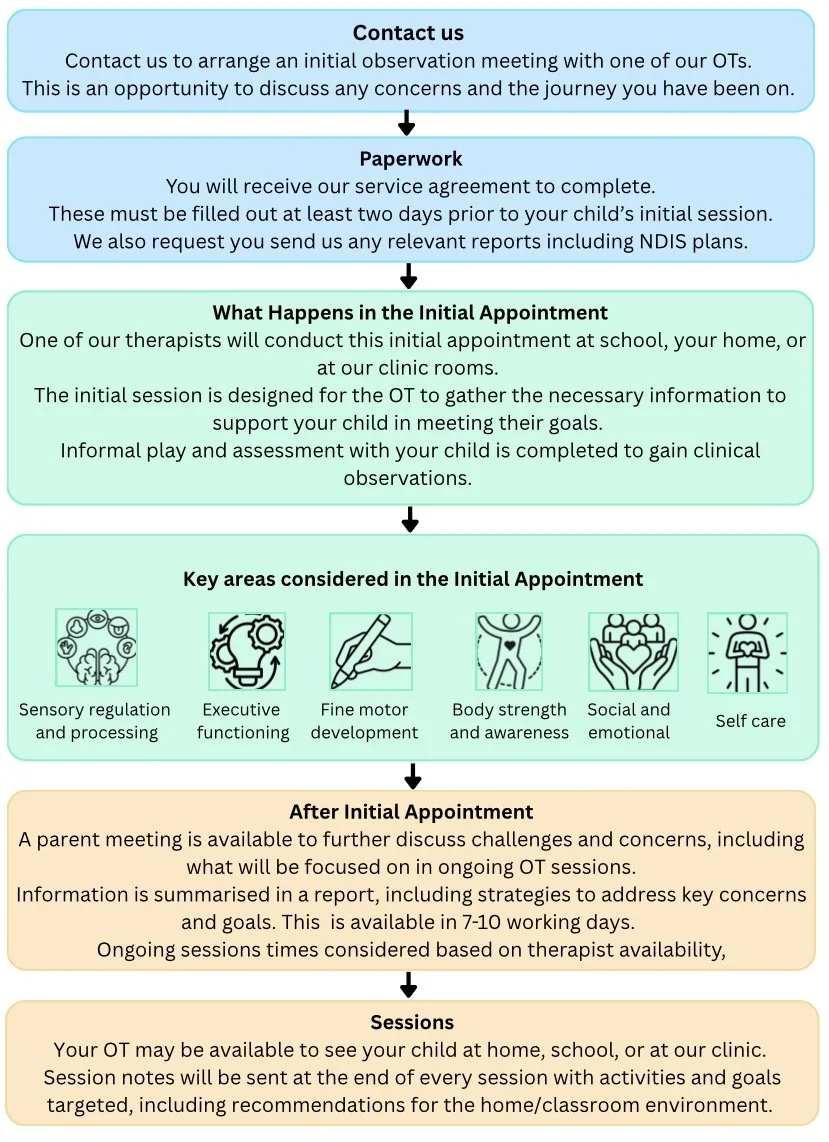
Initial occupational therapy assessments can take place at the school, clinic or home. During this session, the OT gathers information through clinical observations, discussions, and activities to better understand the client’s strengths, challenges, and goals. Additional assessments such as Functional Assessments, Sensory Assessments, or Handwriting assessments may be recommended if further information is required.
At school, the OT is introduced in a supportive and inclusive way to allow for natural observation within the classroom environment. The OT may observe in class or complete individual activities with the client, while also collaborating with teachers and support staff. The OT will decide what the best process is based on your child’s presentation and goals.
At the clinic, the OT works closely with the parent and client to discuss daily functioning, areas of concern, and therapy goals, while completing a range of activities and exercises to assess overall functioning.
We can also offer a parent phone-call after the initial observation to discuss any aspects from a home perspective. This is charged at the normal session rate. Our preference is to have more communication with the parent after the assessment so that the therapist has more information and can be making recommendations rather than it be more generic and not specific to your child. Please also provide detailed information in our service agreement that is sent out prior to the assessment.
Following the completion of the assessment process, assessment reports, findings, and recommendations will initially be provided to parents/carers for review and approval. This ensures families have the opportunity to discuss the information, ask questions, and provide consent prior to the report being shared with the broader support team, school staff, medical professionals, or other external service providers involved in the client’s care.
Please see diagram below:
DASH
The DASH (Detailed Assessment of Speed of Handwriting) is a standardized assessment used to evaluate a child or adolescent’s handwriting speed and writing efficiency. It is commonly used by occupational therapists, psychologists, and educators when handwriting difficulties are impacting school participation and written output.
The DASH assesses how quickly and efficiently a student can produce written work under different conditions, helping clinicians determine whether handwriting speed is significantly below age expectations.
Handwriting Assessments:
ETCH
The ETCH (Evaluation Tool of Children’s Handwriting) is a standardised handwriting assessment used by occupational therapists to evaluate a child’s functional handwriting skills within school-based tasks. It assesses both the legibility and speed of handwriting to identify difficulties that may be impacting classroom participation and written communication.
The ETCH focuses on how effectively a child can complete everyday handwriting tasks, including manuscript and cursive writing, numeral formation, copying, dictation, and sentence composition.
Handwriting Speed Test
A Handwriting Speed Test is used by occupational therapists to assess how quickly and efficiently a child can produce written work compared to age-based expectations. The assessment helps identify whether handwriting speed may be impacting classroom participation, written output, task completion, and overall academic performance. The occupational therapist will observe handwriting fluency, endurance, legibility, pencil grasp, posture, and motor coordination.
McMaster Assessment
The McMaster Assessment is a standardised occupational therapy assessment used to evaluate a child’s handwriting readiness and visual-motor integration skills. It helps identify underlying difficulties that may impact handwriting performance, including posture, pencil grasp, fine motor control, visual perception, motor planning, and letter formation.
Our occupational therapists use this assessment to gain a clearer understanding of the factors influencing a child’s written output and classroom participation.
Full Functional Capacity Assessments
BOT - 3 Assessment
The BOT-3 is a comprehensive assessment used to evaluate a child’s fine motor and gross motor skills. This standardised assessment helps identify difficulties with coordination, balance, strength, handwriting-related skills, dexterity, and overall motor development.
Our occupational therapists use the BOT-3 to better understand how motor challenges may be impacting a child’s participation in everyday activities such as school tasks, play, self-care, sports, and social engagement.
ABAS
The Adaptive Behaviour Assessment System (Third Edition) is the preferred functional assessment. It measures important behaviours and individual displays at home, school, work, and in other settings. It assesses the areas of communication, community use, functional academics, home living, health and safety, leisure and self-care. This can be used to assist with funding applications. The therapist will then complete a report with the results and recommendations.
Sensory Processing Measure
The Sensory Processing Measure (SPM) is a standardised assessment used by occupational therapists to evaluate how a child processes and responds to sensory information within everyday environments such as home, school, and the community. The assessment gathers information from parents, teachers, and caregivers to better understand how sensory processing may be impacting the child’s participation, behaviour, emotional regulation, social interactions, learning, and daily functioning.
The SPM assesses areas including visual, auditory, tactile, body awareness, balance and movement, motor planning, and social participation.This can be highly beneficial for developing an individualised and tailored ‘Sensory Diet’.
Zarit Carer Burden Scale
This is a widely used assessment tool that measures the level of stress or burden experienced by caregivers (carers) who are supporting someone with illness, disability, dementia, mental health conditions, or age-related decline.
Sensory Profile 2
The Sensory Profile 2 (SP-2) is a standardised assessment used by occupational therapists to evaluate how a child processes and responds to sensory information in everyday environments. The assessment is completed through questionnaires by parents, teachers, or caregivers and provides insight into how sensory processing may impact a child’s emotional regulation, behaviour, attention, social participation, learning, and daily functioning.
The SP-2 assesses responses across a range of sensory processing areas including auditory, visual, touch, movement, oral and body position. It also looks at how behaviours associated with sensory processing including conduct, social emotional responses and attentional responses.
The SP-2 includes the four quadrants: Seeking/Seeker, Avoiding/Avoider, Sensitivity/Sensor and Registration/Bystander.
OT Services
Ongoing Sessions
Ongoing OT and AHA sessions aim to support the development of skills necessary for daily activities, play, and social interaction, in a safe, fun and engaging manner. Working towards achieving the short and long term goals of the client.
Transition Review/Meeting
Therapists can complete a transition document to support transitions. This may include starting kindergarten or school, moving to a new school, moving to a new grade or moving from primary to high school. This is highly beneficial to ensure a collaboratively approach to best support the child.
Parent/Teacher Meetings & Sessions
It can be beneficial to have parent and teacher meetings to discuss the progress that has occurred and next steps. It is beneficial to provide updates to the therapist so that they can continue to change their goals and focus of sessions. It can also be beneficial to have parent coaching sessions to demonstrate how the families can be building the OT strategies into the home environment to ensure consistency.
Allied Health Assistant (AHA)
Supports occupational therapists to deliver therapy services and assist clients to achieve their goals. They work under the supervision and direction of a qualified occupational therapist and may assist with therapy preparation, implementation of therapy programs, administration tasks, and client support across a range of settings