COT frequently asked questions:
Q: What is OT?
A: Occupational Therapists (OT’s) at Connecting OT are all about building success that your child needs to work on and experience within their functional environments. This process involves observing and addressing a combination of factors that affect the ability to experience success and complete specific tasks or a range of tasks at home, at school or kinder and particularly transitioning between activities.
We work to observe areas such as muscle tone and strength, generally through the body and effects on tasks. We look at the motor planning and executive functioning abilities needed to know how to start, transition and sequence through tasks. We also look at the ability to concentrate, stay on track and emotionally regulate throughout this process.
Goals are developed and continuously fine-tuned with input from the teacher, parents and the child. Key areas addressed are organisation, concentration, social skills, gross motor development, fine motor development, such as handwriting and sensory regulation.
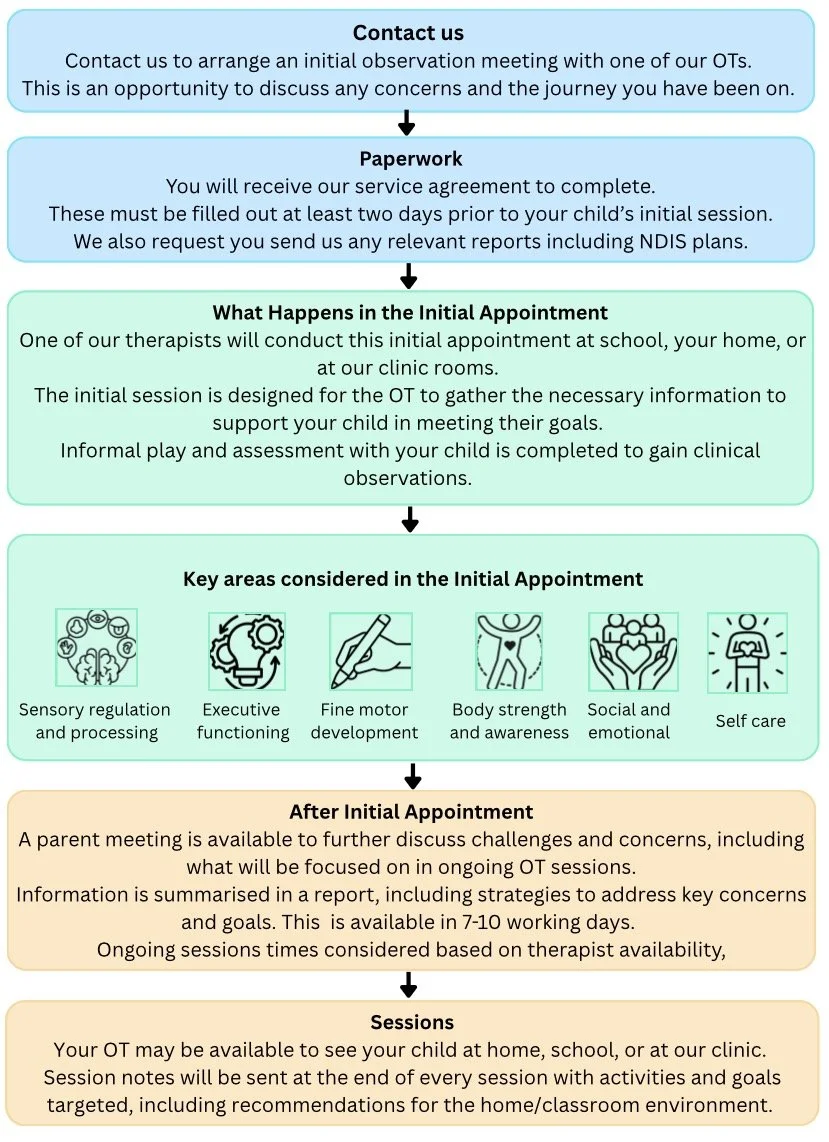
Q: What is the process to getting started with OT?
A: We try to make this process as streamlined as possible. We have detailed the process in the flow chart below for ease of viewing and understanding.
Q: Does my child need a diagnosis to work with an OT?
A: No, your child does not need a diagnosis to engage with us. While diagnoses can help children and families to understand their presentation and at times provide access to different funding models, this is not a requirement to engage with an OT.
We work to support functional engagement for your child. This may mean working to support them on key goal areas identified through the initial assessment process to support their engagement in their activities of daily living and key occupations that are expected for their age. We want your child to thrive in their lives and will work with you to support them to flourish.
Q: What can I expect from the initial assessment?
A: You will be allocated one of our therapists depending on the time of your booking. We have a team of OTs and AHAs to ensure we can offer a range of times. It may be that you have two therapists for your initial booking, so there is more ability to discuss and then one therapist for follow-up sessions.
The initial session time is designed for the OT to gather the information needed. This is done by a combination of:
Discussions with parents are challenges and concerns.
Informal play with your child to gain invaluable clinical observations.
Information will be given verbally and then summarised in the report regarding the strategies that will need to be worked on to address the key concerns and goals.
Key areas that are considered within this initial observation are (but not limited too):
Sensory regulation and processing
Executive function/planning and problem-solving skills
Fine motor development
Body strength and awareness
Social and emotional development.
It is important to note that you may not expect some of these areas to be related to your key concerns. It is our job to work out what is at the root of the problem and how we can work to change the behaviour and address the goals. This is especially the case when it comes to toilet-related concerns, eating-related concerns, behaviour-related concerns, and anxiety-related concerns.
Q: What is the price for an OT session?
A: We follow the pricing guide set by the NDIS for occupational therapy sessions. While we understand not everyone has access to funding for occupational therapy, there are other funding models that can be considered to support access to services, as well as paying out of pocket.
We accept the Better Access to Mental Health rebate through Medicare, Enhanced Primary Care (team care plan) through Medicare, Complex Neurodevelopmental Care Plan through Medicare, Private Health Insurance, and NDIS (National Disability Insurance Scheme).
Please enquire with our administration team if you have more questions around pricing.
Q: What is the key difference between having an initial assessment at school/kinder or our rooms?
A: The basis of all our initial assessments is to have time to observe your child completing a range of activities. When it is in the school or kinder environment, these will be the regular activities the class is completing to support a natural environment, and we do the best that we can to remain inobtrusive, so that the child does not feel singled out.
In the rooms environment the activities might not necessarily reflect the key goals and reasons for referral but are designed for us to get the clinical observations that we require based on the information that you have given us and what we see at that time.
Q: What happens if the therapist hasn’t received my paperwork before the initial assessment?
A: Whilst it is critical that we receive the service agreement and information prior to the assessment and we appreciate that our clients and the admin team work to the best of their ability to facilitate this process, there are sometimes times that additional reports have not been provided to the therapist. Please be rest assured that the process of the clinical observation goes hand in hand with the therapist’s ability to read over additional reports in preparation for completing the OT report.
Q: Should the parents be attending the initial sessions?
A: At school and kinder it is our preference that parents do not attend, as we wish to have an organic understanding of where the child is at without additional distractions and having a parent in the class environment would most likely change the nature of this experience.
However, if your initial appointment is at the rooms, it might be that your therapist is observing the interactions between you and your child, for example your child may be unfamiliar being at the rooms and experiencing emotions accordingly, this gives us information of how we can best help moving forward. Conversely, your therapist might suggest that they have some one-on-one time with the child and will then have a discussion time with you towards the end of the session.
Q: How many sessions will my child require?
A: This will vary for each child and their individual challenges. Some children require more ongoing and consistent support, while others may be able to implement strategies highlighted themselves with family and school support and be monitored from there. However, we do recommend that it is typically good to have a run of sessions to work on goals and develop new habits in the functional setting.
We usually suggest that if you are unsure, a term worth of sessions is usually a good starting point to understand the child’s engagement, their ability to develop rapport and a therapeutic relationship with the therapist, and the child’s availability to participate in strategies that support their development towards their goals.
Our therapist always promote communication and if you have any questions about current capacity, their progress and continuation of services; they are always happy to have a conversation about this.
Q: Who informs COT/therapist my child will be/is absent from school?
A: Our policy is that it is the family’s responsibility to inform COT admin or the therapist if your child is or will be absent from school. This is also in relation to any planned excursions, parent teacher interviews or other absences from school when the scheduled appointment time is.
We require parents to inform us so that we can either cancel the session, reschedule for a different time, or provide a different service in its place in line with our cancellation policy.
Q: What is sensory?
A: Sensory processing refers to how efficiently the body interprets and responds to sensory information. Sensory information is provided to the body and brain through the below inputs:
Vision (Sight): Detecting light, colour, shapes, and movement.
Audition (Hearing): Perceiving sounds, tones, and volume.
Olfaction (Smell): Sensing odours from the environment.
Gustation (Taste): Detecting flavours such as sweet, salty, sour, and bitter.
Tactile (Touch): Feeling textures, pressure, and temperature.
Proprioception: Awareness of body position and movement without visual cues.
Vestibular Sense: Balance and spatial orientation, helping prevent falls.
Interoception: Sensing internal body states, like hunger, thirst, or fatigue.
Since everyone has unique sensory preferences and sensitivities, it’s important to understand how we each process input from a perspective of likes and dislikes. When sensory overload occurs, our ability to absorb information or follow instructions decreases. Understanding sensory inputs can guide strategies for self-regulation, learning, and creating supportive environments; impacting on overall daily life and functioning.
Q: Do you offer Functional Capacity Assessments for NDIS?
A: Yes, we do offer functional capacity assessments. At Connecting OT, we use ABAS-3 functional and behaviour assessment in line with the NDIS recommendations.
If you require this assessment, please reach out to us and we can start the process of completing this for your child.